This episode was mostly about the Greek aspect of the European Debt Crisis. Here is the audio split into 5 parts.
1.
2.
3.
4.
5.
Showing posts with label economy. Show all posts
Showing posts with label economy. Show all posts
Wednesday, January 25, 2012

Sunday, August 14, 2011
Interview with two leading economists on jobs
NPR's John Ydstie interviewed economists Joseph Stiglitz and John Taylor about ways to strengthen the economy.
NPR audio, mp3. Let me know if you'd like the audio cached.
NPR audio, mp3. Let me know if you'd like the audio cached.
Monday, May 16, 2011
Education Debt vs. Employment Wages
This was an interesting report on Morning Edition this morning. It makes the direct statement that education costs should be weighed against potential future earnings in that future profession. That can be a wager in and of itself because of our uncertain future economy. There are enough wildcards that it can become a simple WAG as more and more professions are outsourced to the developing world. Who knows which professions are most likely to continue receiving first world level wages? Audio: (mp3) and cached here.
Also, here is another related discussion. Last week Terry Gross discussed for profit colleges vs. more traditional colleges (universities, community colleges, trade schools, etc.). Audio: (mp3) and cached here:
1.
2.
3.
Also, here is another related discussion. Last week Terry Gross discussed for profit colleges vs. more traditional colleges (universities, community colleges, trade schools, etc.). Audio: (mp3) and cached here:
1.
2.
3.
Saturday, May 14, 2011
Super Sad True Love Story
Terry Gross interviewed Gary Shteyngart on Friday's Fresh Air. I want to read his book in the next couple of weeks.
Audio: (mp3) and cached here:
1.
2. to submit a book, you must show a receipt that you've bought a book
3.
4.
Update: 2011-05-21
I've started reading it, enough to get the flavor. It's a dystopian future and it's scary, all right. Unfortunately, his future world is plausible; it's a warning like Orwell's 1984, telling us to do something before it's too late. Set in the near future, the United States debt to China is 65 trillion Yuan-pegged dollars. The country is in the middle of being hollowed out to keep making the payments. Telling China to chill, you'll get your money! isn't working so well anymore. I have discussed the book's major themes on this blog: digital culture, economic trends, privacy, and freedom. His novel blends them all together and simply projects the current trend into the future.The vision is very much comparable to Judge's Idiocracy. People's attention spans have been reduced to the point that they haven't ever read any books. They haven't even read the Cliff Notes version. In the future, all information is streamed. Trying to get a message through that isn't streamed is not possible. It's also important to do things to keep the stream's ratings up- spice it up a little. It helps to intersperse your message (be it politics, cooking, live party streams) with the same characters doing some form of porn. That works with all of those topics- politics plus porn, cooking plus porn- it just keeps the audience's attention much better. Remember, telling your audience to go read anything is a non-starter. Anyone who still reads physical books is shunned. Just what have you got there, grandpa? So, if you really have something serious to say, and it's longer than a tweet, then you're going to have a tough time getting through. Sure, the text version is available online- it's just too long to ever matter to anyone. Dude, can't you give me the tl;dr version?
Personal privacy is a thing of the past. The TSA has run amok. No one cares because they have put all of their information online anyway. Who care's if someone goes through you're bag if you've already given them access to your 24 hour personal stream? Telephone poles display your credit rating when you walk passed them. People like to reveal information so they can find their social status in any given place. Personal devices, the aparat, include a feature to advertise your relevent scores. The data from Rate Me Plus is out there, free for everyone to see and decide if they should interact with you. This page shows the typical output from the aparat.
The government is broke and can't pay its debts and obligations. The fight for oil has most recently led the US Army to Venezuela. The Army was promised a bonus, and the government won't pay, an echo of WW I Bonus Army.. Government functions have been outsourced to corporations. The infrastructure is falling apart. Property with any value is being retrofitted and marketed to foreigners with money. Current tenants are forced out onto the street. Anything and everything will be done to pay off the debt. I am not sure I am going to like the ending...it really could be super sad.
Update: 2011-05-24
Finished reading it -- no spoilers from me. I can only say it left me reeling, not feeling so well.
Update: 2011-05-25
After finishing the book, I turned on NPR and these news stories popped up. They both show the trends of the power of the digital culture and the power of media figures.
Now that Oprah is ending her show, everyone will need to follow her on Twitter.
Audio: (mp3) and cached here:
1.
2. to submit a book, you must show a receipt that you've bought a book
3.
4.
Update: 2011-05-21
I've started reading it, enough to get the flavor. It's a dystopian future and it's scary, all right. Unfortunately, his future world is plausible; it's a warning like Orwell's 1984, telling us to do something before it's too late. Set in the near future, the United States debt to China is 65 trillion Yuan-pegged dollars. The country is in the middle of being hollowed out to keep making the payments. Telling China to chill, you'll get your money! isn't working so well anymore. I have discussed the book's major themes on this blog: digital culture, economic trends, privacy, and freedom. His novel blends them all together and simply projects the current trend into the future.The vision is very much comparable to Judge's Idiocracy. People's attention spans have been reduced to the point that they haven't ever read any books. They haven't even read the Cliff Notes version. In the future, all information is streamed. Trying to get a message through that isn't streamed is not possible. It's also important to do things to keep the stream's ratings up- spice it up a little. It helps to intersperse your message (be it politics, cooking, live party streams) with the same characters doing some form of porn. That works with all of those topics- politics plus porn, cooking plus porn- it just keeps the audience's attention much better. Remember, telling your audience to go read anything is a non-starter. Anyone who still reads physical books is shunned. Just what have you got there, grandpa? So, if you really have something serious to say, and it's longer than a tweet, then you're going to have a tough time getting through. Sure, the text version is available online- it's just too long to ever matter to anyone. Dude, can't you give me the tl;dr version?
Personal privacy is a thing of the past. The TSA has run amok. No one cares because they have put all of their information online anyway. Who care's if someone goes through you're bag if you've already given them access to your 24 hour personal stream? Telephone poles display your credit rating when you walk passed them. People like to reveal information so they can find their social status in any given place. Personal devices, the aparat, include a feature to advertise your relevent scores. The data from Rate Me Plus is out there, free for everyone to see and decide if they should interact with you. This page shows the typical output from the aparat.
The government is broke and can't pay its debts and obligations. The fight for oil has most recently led the US Army to Venezuela. The Army was promised a bonus, and the government won't pay, an echo of WW I Bonus Army.. Government functions have been outsourced to corporations. The infrastructure is falling apart. Property with any value is being retrofitted and marketed to foreigners with money. Current tenants are forced out onto the street. Anything and everything will be done to pay off the debt. I am not sure I am going to like the ending...it really could be super sad.
Update: 2011-05-24
Finished reading it -- no spoilers from me. I can only say it left me reeling, not feeling so well.
Update: 2011-05-25
After finishing the book, I turned on NPR and these news stories popped up. They both show the trends of the power of the digital culture and the power of media figures.
Now that Oprah is ending her show, everyone will need to follow her on Twitter.
Friday, May 13, 2011
DIY: Rockstar
This was an interesting report today from NPR's Planet Money team. It is more evidence that cutting out the middleman is not only possible, it is profitable as well. It used to be that an appearance on Johnny Carson guaranteed stardom. Has the mantle been passed to Slashdot/Reddit/etc. ?
Story: Audio (mp3) and cached here.
I last wrote about this new marketplace here.
Story: Audio (mp3) and cached here.
I last wrote about this new marketplace here.
Monday, May 9, 2011
Short Joseph Stiglitz Interview
Steve Inskeep interviewed economist, Joseph Stiglitz, on Morning Edition. Audio: (mp3) and cached here.
Thursday, May 5, 2011
Monday, May 2, 2011
Propublica wins Pulitzer for Magnetar Reporting
Check out today's Fresh Air. A question came up which involved the term, insurable interest. The question wondered whether the entire meltdown could be attributed to a lack of an insurable interest by those using the Magnetar stategy. I think the guests' answer was that they placed more of the blame on those selling insurance (AIG), than those buying it. The insurers had "whiffed" (seriously underestimated risk) at setting the prices for those wanting to buy insurance for CDOs. If a proper price had been set, then Magnetar couldn't have been using that strategy, at least not profitably. Listen for the big finish of the broadcast, broadway style!
The interview audio is cached here:
1.
2.
3.
Here is my blog entry from last April which has a link back to This American Life.
Update: 2011-05-03
I have been meaning to write something about the documentary Inside Job. It is definitely recommended for anyone who wants to know more about the recent economic meltdown. The facts roll out pretty quickly, and it's a lot to digest in one sitting. It's probably best to take it in in smaller bites. That strategy also helps stop you from getting so mad that you start throwing things and/or breaking up the furniture. Anyway you slice it, the movie doesn't paint a pretty picture of how we got here to this current state of affairs. We were led by the "so called" free marketeers that demanded deregulation. That movement caught its stride in the mid 1990s with deregulation bills signed by Clinton that rolled back some of the major safeguards put in place after the 1930's depression. In this new era, governments all around the world were working hard to outdo one another, by easing banking rules and deregulating complex financial instruments. They were aided by the economists they had in their back pocket (Greenspan, Summers, et. al). At first, Greenspan tried to halt the irrational exuberance in the market. Eventually, he relented and decided to go along with the rising tide. With Greenspan on board, no one else of consequence was willing to call the bubble a bubble. Everyone now had been given rose colored glasses. They were working with one main fundamental assumption: the future trend is always positive- prices only go up. That assumption works; that is, until it doesn't. Oops! When the trend reversed, even in the slightest degree (as documented by the Propublica reporting), insolvency rapidly entered the picture. The banks were effectively wiped out over night. They went to Congress and to the Fed and asked for super massive bailouts. I have a hard time with this because these "free marketeers" had convinced me. I'm okay with having a free market, as long as everyone knows the rules are the same for everyone all of the time. Please, note it was the bankers that have turned against the rules of the free market. They did so after looking at their balance sheets. They changed their mind for simple self-preservation. They'd do anything, including reversing course, if it meant avoiding their demise. They needed the bailouts to survive. It's much like a 6 year old changing the rules in the middle of a boardgame, just because they are losing. We, as the adults in the room, felt bad for them, and were coerced into changing the rules for them. Little did we know that the frequent rule changes are a violation of the fudamental rules of the game, a perversion of how capitalism is supposed to work. The changes allowed the banks to socialize their losses. They just hope we will forget that they were all too happy to ride the wave at the other end of the spectrum; that is, they were definitely in favor of privatizing their profits when times were good. Now, it's just too bad, since we didn't hold their feet to the fire when we had the chance. I have to wonder, where was the public outcry that should've demanded that deregulation (as adopted) be enforced. Those rules demanded that everyone else must "stay out" and the game be played to its conclusion. Fairness demands that the rules be the same in both good times and in bad times. The system as it is now is a far cry from Adam Smith's invisible hand. It's more like a giant visible hand that jumps in at the last minute to prop up losers that should've been written off much earlier. Again, too bad for us. Good luck paying off the multi-trillion dollar debts!
An interesting part of the movie is the interviews with economists who led the charge for deregulation. Most have now retreated back to academia, and without exception, they have all landed on their feet. Still, these "great minds" don't come across as particularly intelligent. Two extremely dopey examples still stand out in mind, and even after several months have gone by since seeing the movie: Martin Feldstein (Harvard) and Glenn Hubbard (Columbia). As dumb as they come across, it's amazing that they can be hired anywhere, let alone those prestigious universities. To add insult to injury, wikipedia claims Feldstein is still a perennial candidate for the Nobel prize. Simply amazing! Another irony is that of those interviewed, Elliot Spitzer comes across as one of the most sane voices in the room.
This movie won the Oscar for best documentary of the year. In my opinion, it could have been the best movie of last year. It is the best of those that I have managed to see so far.
Note: There were a few textual changes in today's post. It took a few tries to get what I wanted to say in the proper syntax.
The interview audio is cached here:
1.
2.
3.
Here is my blog entry from last April which has a link back to This American Life.
Update: 2011-05-03
I have been meaning to write something about the documentary Inside Job. It is definitely recommended for anyone who wants to know more about the recent economic meltdown. The facts roll out pretty quickly, and it's a lot to digest in one sitting. It's probably best to take it in in smaller bites. That strategy also helps stop you from getting so mad that you start throwing things and/or breaking up the furniture. Anyway you slice it, the movie doesn't paint a pretty picture of how we got here to this current state of affairs. We were led by the "so called" free marketeers that demanded deregulation. That movement caught its stride in the mid 1990s with deregulation bills signed by Clinton that rolled back some of the major safeguards put in place after the 1930's depression. In this new era, governments all around the world were working hard to outdo one another, by easing banking rules and deregulating complex financial instruments. They were aided by the economists they had in their back pocket (Greenspan, Summers, et. al). At first, Greenspan tried to halt the irrational exuberance in the market. Eventually, he relented and decided to go along with the rising tide. With Greenspan on board, no one else of consequence was willing to call the bubble a bubble. Everyone now had been given rose colored glasses. They were working with one main fundamental assumption: the future trend is always positive- prices only go up. That assumption works; that is, until it doesn't. Oops! When the trend reversed, even in the slightest degree (as documented by the Propublica reporting), insolvency rapidly entered the picture. The banks were effectively wiped out over night. They went to Congress and to the Fed and asked for super massive bailouts. I have a hard time with this because these "free marketeers" had convinced me. I'm okay with having a free market, as long as everyone knows the rules are the same for everyone all of the time. Please, note it was the bankers that have turned against the rules of the free market. They did so after looking at their balance sheets. They changed their mind for simple self-preservation. They'd do anything, including reversing course, if it meant avoiding their demise. They needed the bailouts to survive. It's much like a 6 year old changing the rules in the middle of a boardgame, just because they are losing. We, as the adults in the room, felt bad for them, and were coerced into changing the rules for them. Little did we know that the frequent rule changes are a violation of the fudamental rules of the game, a perversion of how capitalism is supposed to work. The changes allowed the banks to socialize their losses. They just hope we will forget that they were all too happy to ride the wave at the other end of the spectrum; that is, they were definitely in favor of privatizing their profits when times were good. Now, it's just too bad, since we didn't hold their feet to the fire when we had the chance. I have to wonder, where was the public outcry that should've demanded that deregulation (as adopted) be enforced. Those rules demanded that everyone else must "stay out" and the game be played to its conclusion. Fairness demands that the rules be the same in both good times and in bad times. The system as it is now is a far cry from Adam Smith's invisible hand. It's more like a giant visible hand that jumps in at the last minute to prop up losers that should've been written off much earlier. Again, too bad for us. Good luck paying off the multi-trillion dollar debts!
An interesting part of the movie is the interviews with economists who led the charge for deregulation. Most have now retreated back to academia, and without exception, they have all landed on their feet. Still, these "great minds" don't come across as particularly intelligent. Two extremely dopey examples still stand out in mind, and even after several months have gone by since seeing the movie: Martin Feldstein (Harvard) and Glenn Hubbard (Columbia). As dumb as they come across, it's amazing that they can be hired anywhere, let alone those prestigious universities. To add insult to injury, wikipedia claims Feldstein is still a perennial candidate for the Nobel prize. Simply amazing! Another irony is that of those interviewed, Elliot Spitzer comes across as one of the most sane voices in the room.
This movie won the Oscar for best documentary of the year. In my opinion, it could have been the best movie of last year. It is the best of those that I have managed to see so far.
Note: There were a few textual changes in today's post. It took a few tries to get what I wanted to say in the proper syntax.
Wednesday, April 13, 2011
MIA: Obama
Check out Krugman's recent article in the NY Times on Obama. He'd better outline some real strategy soon, because this "no vision" thing is setting himself up to be voted out. The spark of his election is rapidly dying out. There's no use saving it up- now is the time!
Also, check out this recent radio program, On Point. Several callers nailed down the problems with our current government.
We need direction and leadership. How about proposing a national energy policy based on renewables, with a real commitment to get off fossil fuels. Renewable energy is looking cheaper all of the time, considering the unknown long term losses that the Chernobyl and Fukishima nuclear accidents will impose. Consider that the human element is enough of a problem, let alone the unpredictability of nature, and the 20,000+ year dangerous halflife of waste products. As currently built, nuclear is expensive. But I wonder, have our own major faults been adequately considered in our nuclear plant designs? The New Madrid fault is the elephant in the room. I hope it's not another case of an initial lowball estimate- the same kind of thing that allowed a 5.2m seawall, when a characteristic tsunami required a 10m. But, a 10m wall would have been cost prohibitive, and probably have put brakes on the entire project. Try out these slightly different lyrics played to the same tune,
Crosses fingers...
Update: 2011-04-14
Obama gave an important speech on the topic yesterday at George Washington University.
Listen to it here:
1. Joe Biden is here. Tim Geithner is in the house...
2.
3.
4. "vision" is the keyword...
This speech is just too little, too late. 20/20 hindsight looks like he should have made redefining the tax code/rates his highest priority as president, certainly higher than health care reform. Now, he's a lot weaker because he seems to have already bought into the Republican agenda by agreeing to extend Bush-era tax cuts, even if only temporarily. The loss of the House enforces a stalemate. Now, nothing is going to change. The Republicans are going to circle wagons, and wait until 2012 and see if they can win the presidency. Obama's tone hinted that he knew it, too. That said, Obama's speech had a lot of good ideas, and I agree with all of his tax reform points. It's too bad that he glossed over energy. He really should have used this speech as an opportunity to state a Kennedy-like goal for national energy independence through renewables. He made no mention of the Japanese disaster, and the pall it casts over nuclear power.
If the speech was a cornerstone on taxes, then it was short on numbers, because even stating a tax rate for the rich is too controversial. To sell tax reform, hard numbers will be required. A proposal needs to offer simplification in exchange for an overall lower tax rate. The lower tax rate is possible because everyone has to pay! No loopholes, like I said, in an earlier post! I would like a flat tax with very limited deductions. The only deductions that I think should be allowed is a deduction for state taxes paid, and pretty much nothing else.
Also, check out this recent radio program, On Point. Several callers nailed down the problems with our current government.
We need direction and leadership. How about proposing a national energy policy based on renewables, with a real commitment to get off fossil fuels. Renewable energy is looking cheaper all of the time, considering the unknown long term losses that the Chernobyl and Fukishima nuclear accidents will impose. Consider that the human element is enough of a problem, let alone the unpredictability of nature, and the 20,000+ year dangerous halflife of waste products. As currently built, nuclear is expensive. But I wonder, have our own major faults been adequately considered in our nuclear plant designs? The New Madrid fault is the elephant in the room. I hope it's not another case of an initial lowball estimate- the same kind of thing that allowed a 5.2m seawall, when a characteristic tsunami required a 10m. But, a 10m wall would have been cost prohibitive, and probably have put brakes on the entire project. Try out these slightly different lyrics played to the same tune,
That fault hasn't produced any major activity since 1812. And that was a fluke.
Crosses fingers...
Update: 2011-04-14
Obama gave an important speech on the topic yesterday at George Washington University.
Listen to it here:
1. Joe Biden is here. Tim Geithner is in the house...
2.
3.
4. "vision" is the keyword...
This speech is just too little, too late. 20/20 hindsight looks like he should have made redefining the tax code/rates his highest priority as president, certainly higher than health care reform. Now, he's a lot weaker because he seems to have already bought into the Republican agenda by agreeing to extend Bush-era tax cuts, even if only temporarily. The loss of the House enforces a stalemate. Now, nothing is going to change. The Republicans are going to circle wagons, and wait until 2012 and see if they can win the presidency. Obama's tone hinted that he knew it, too. That said, Obama's speech had a lot of good ideas, and I agree with all of his tax reform points. It's too bad that he glossed over energy. He really should have used this speech as an opportunity to state a Kennedy-like goal for national energy independence through renewables. He made no mention of the Japanese disaster, and the pall it casts over nuclear power.
If the speech was a cornerstone on taxes, then it was short on numbers, because even stating a tax rate for the rich is too controversial. To sell tax reform, hard numbers will be required. A proposal needs to offer simplification in exchange for an overall lower tax rate. The lower tax rate is possible because everyone has to pay! No loopholes, like I said, in an earlier post! I would like a flat tax with very limited deductions. The only deductions that I think should be allowed is a deduction for state taxes paid, and pretty much nothing else.
Friday, April 1, 2011
Hits the proverbial nail...
Yesterday, Diane Rehm interviewed Bernie Sanders, senator from Vermont. They discuss the shift of the center of the political spectrum toward the right. Sanders hits a lot of right notes in this interview- I'd vote for him. He voiced the opposition to extending the Bush era tax cuts; explains the extent to which wealth is being concentrated by the few; the destruction of the middle class; the decimation of the manufacturing labor base; the bailouts for the rich at the expense of the poor; and he doesn't spare our president. Sanders notes how much of missed opportunity we've had with him not living up to the promise for "change." Instead we've gotten a lot more of the same. By postponing taking a stand, we're just catering to the interests of the rich. If you weren't cynical about this country before, then you should be! We were wrong thinking that business doesn't control this country- the Supreme Court drove the point home, just in case we missed it.
Definitely worth listening to.
Update: 2011-05-01
Sanders appeared on the Daily Show with Jon Stewart.

Definitely worth listening to.
p.s.
Socialism never took root in America
because the poor see themselves
not as an exploited proletariat,
but as temporarily embarrassed millionaires.
Update: 2011-05-01
Sanders appeared on the Daily Show with Jon Stewart.
Wednesday, March 23, 2011
Time for a national sales tax?
The sales tax is often called a regressive tax because it hits people living paycheck to paycheck hardest. However, the current tax situation is far from ideal. There are entire financial industries set up to help people with high incomes find loopholes and tax shelters. Not to mention that the complexity of the current system has a significant slice of world labor preparing tax forms. That's a lot of wheels spinning, but all for nothing. I would favor replacing our current byzantine national income tax system with a national sales tax, a VAT, or flat income tax. We need simplification where everyone just has to pay. No loopholes.
Here's another case on point. Did you know that Google is an Irish company? I thought they were from silicon valley, California. Nope. Maybe, they're a Bermuda corp. Who knows? All the world corporations are playing games with their money to minimize their tax bill. They're pushing their money around just like poker chips or Monopoly money. Check this recent discussion on Fresh Air.
Here's another case on point. Did you know that Google is an Irish company? I thought they were from silicon valley, California. Nope. Maybe, they're a Bermuda corp. Who knows? All the world corporations are playing games with their money to minimize their tax bill. They're pushing their money around just like poker chips or Monopoly money. Check this recent discussion on Fresh Air.
Thursday, December 9, 2010
No millionaire left behind...
 .
.Meet the new boss. Same as the old boss. I swore I wouldn't get fooled again. How different would things be if McCain had been elected? Ok, there would be that "one heartbeat away" fear factor. Beside that, not a dime's worth of difference. No banker has been left behind*. Meanwhile, gold is at over $1400; it doesn't look like the dollar will last much longer as the world reserve currency. It doesn't send a good message to the world credit markets if the richest Americans can't tighten their belts even one notch.
Obama better start appealing to his base- lest he ends up as another Jimmy Carter, or worse. He may only get one chance to make any difference; might as well make the most of it. We want someone who will fight for us, not just "itch" for a fight. The right wing is already calling this decision his Neville Chamberlain moment. The left wing wants him to go back and retake Negotiations 101.
Here is Obama's Dec. 7 news conference:
1.
2.
3. The polls are on our side...
4.
Thursday, November 11, 2010
Another terrific TAL with the Planet Money Team
The "Planet Money" team has done some terrific stories on understanding the whole financial mess, going back to their first one where they explained the spaghetti of knots that tied CDOs (collateral debt obligations) together. Their latest story is the summary of their idea to buy a toxic asset and hope for the best. The reporters put down $1000 dollars of their own money to buy "Toxie", the toxic asset, a mortgage backed security. It was pretty much a roulette style bet for them. Actually, they had a better chance on red/black, because that is close to a 50-50 chance of success. The way that they tell their story makes the whole thing a lot more real. They discovered that their toxic asset was a microcosm of the mortgage crisis as a whole.
p.s. This American Life is great radio. The current week's show is available as a free mp3 download directly from their site. Here is the episode about "toxie," the Toxic asset. Also, I am not on iTunes, but it appears you can get back episodes there.
p.s. This American Life is great radio. The current week's show is available as a free mp3 download directly from their site. Here is the episode about "toxie," the Toxic asset. Also, I am not on iTunes, but it appears you can get back episodes there.
Sunday, August 8, 2010
Herbert's Commentary in NY Times
In my opinion, we're not out of this severe recession/depression yet. 10% (reported) unemployment is the elephant in the room. We've traded a big sector of our manufacturing economy in return for (initially) cheaper imports. It's a big question where the laid off workers will find new jobs or retraining in industries still in demand. Even in this economic climate, one area which has remained largely intact is our education system. An educated workforce is essential in today's knowledge based economy. Even though our primary education system can vary widely, and may not match the "Brady Bunch" and "Wonder Years" ideal, at least our university system remains the envy of the world. Foreign students have flocked to the US to receive a "world class" upper-level education. The economic impact can be beneficial for everyone. The universities receive tuition to import students. The student becomes an exported quantity back to his origin, where he can use his skills to level the playing field among all countries. But as the recession/depression lingers, our education system may get bigger cuts as state budgets tighten further. It's a nasty downward spiral, and I'm not sure we'll be able to "pull up" in time. Today's editorial by Herbert in the NY Times is on target.
p.s. Modern economic theory says that recessions/depressions are unnecessary. Spending and the money supply can/should be manipulated to keep the economy humming on all cylinders. This theory is showing some signs of breakage as politicians are showing fear of endlessly increasing deficits. The Keyensian model may work only in a vacuum, and under ideal conditions when more goods and services are necessary. What happens when it is not clear what should be produced? The common anecdote questions whether people should be paid for "digging holes, and filling them back in." It keeps people busy, but does it add to the goods and services that people actually want? The obvious flip side is paying for extended unemployment benefits. There is a lot of wasted labor built into the model already. Couldn't the US benefit from some form of "planned economy" where we get the goods and services we need? It's ironic we can pay for unemployment, but can't pay for teachers to improve our schools, or pay for workers to fix our failing infrastructure, etc. etc.
Update: 2010-08-09
Krugman amplifies the same theme.
Update: 2010-08-13
The radio show On Point discusses the potential for deflation and a continuing downward spiral similar to the Japanese scenario of the 1990s. I have read a fair number of Richard Russell's Dow Theory Letters, and he is fond of saying that the Federal Reserve's entire mission statement can be summarized as "inflate or die." Several of the guests on this radio program expressed their fear of deflation in the same way; they'd rather have runaway inflation than deflation. (This is why Richard Russell refers to all paper currencies as "fiat currencies." All national money supplies are subject to arbitrary internal manipulations, and all national currencies are competing against each other to stay in the same relative ballpark, lest trade be disrupted. National currencies are supposed to be traded commodities- allowed to rise and fall according to market conditions- but some nations are not playing the game; they are undervaluing their currency to prop up exports. In any case, the net effect, is still a race to the bottom for all paper currencies.)
p.s. Modern economic theory says that recessions/depressions are unnecessary. Spending and the money supply can/should be manipulated to keep the economy humming on all cylinders. This theory is showing some signs of breakage as politicians are showing fear of endlessly increasing deficits. The Keyensian model may work only in a vacuum, and under ideal conditions when more goods and services are necessary. What happens when it is not clear what should be produced? The common anecdote questions whether people should be paid for "digging holes, and filling them back in." It keeps people busy, but does it add to the goods and services that people actually want? The obvious flip side is paying for extended unemployment benefits. There is a lot of wasted labor built into the model already. Couldn't the US benefit from some form of "planned economy" where we get the goods and services we need? It's ironic we can pay for unemployment, but can't pay for teachers to improve our schools, or pay for workers to fix our failing infrastructure, etc. etc.
Update: 2010-08-09
Krugman amplifies the same theme.
Update: 2010-08-13
The radio show On Point discusses the potential for deflation and a continuing downward spiral similar to the Japanese scenario of the 1990s. I have read a fair number of Richard Russell's Dow Theory Letters, and he is fond of saying that the Federal Reserve's entire mission statement can be summarized as "inflate or die." Several of the guests on this radio program expressed their fear of deflation in the same way; they'd rather have runaway inflation than deflation. (This is why Richard Russell refers to all paper currencies as "fiat currencies." All national money supplies are subject to arbitrary internal manipulations, and all national currencies are competing against each other to stay in the same relative ballpark, lest trade be disrupted. National currencies are supposed to be traded commodities- allowed to rise and fall according to market conditions- but some nations are not playing the game; they are undervaluing their currency to prop up exports. In any case, the net effect, is still a race to the bottom for all paper currencies.)
Tuesday, July 20, 2010
More evidence that a smart grid is essential
We've already seen that power transmissions between states have low redundancy. Regional power transfers come down to a few critical links which can reach capacity, and can be knocked out when they are needed most. Does Enron and the 2001 California blackouts ring a bell here? Enron's blatant market manipulation took advantage of "deregulation" and a hot spring/summer along the Pacific coast to maximize their bottom line, but at the expense of power consumers. Add forest fires, people's willingness to pay for a utility/necessity and you have a "perfect storm" to gouge consumers to the hilt. Enron effectively set the cost per kilowatt on a daily basis. This worked (for a while) to pad Enron's bottom line, but eventually, the bottom fell out and along with the collapse, the truth came out: the blackouts had been artificially created, essentially a giant hoax perpetrated on the nation.
Almost ten years later, that same power grid is tied together in the same way. It is not up to transmitting power from decentralized sources from green energy. It's ironic that wind/solar farms have to be shutdown when demand is highest because there is insufficient power transmission capacity.
Here is Slashdot's headline.
p.s. This was an interesting broadcast about the aging power grid. Make sure to check the interactive graphic on that page. Note: this was a followup to story which appeared in National Geographic, here.
Almost ten years later, that same power grid is tied together in the same way. It is not up to transmitting power from decentralized sources from green energy. It's ironic that wind/solar farms have to be shutdown when demand is highest because there is insufficient power transmission capacity.
Here is Slashdot's
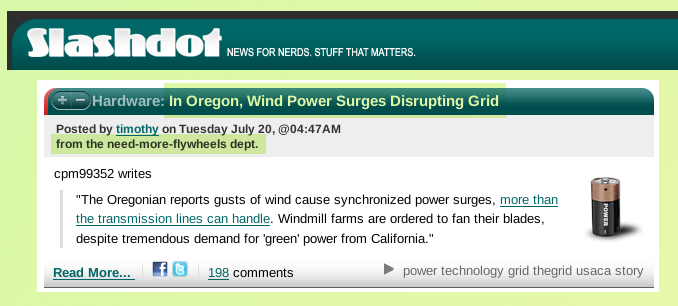 headline.
p.s. This was an interesting broadcast about the aging power grid. Make sure to check the interactive graphic on
that page. Note: this was a followup to story which appeared in National Geographic, here.
Monday, April 12, 2010
Another Discussion about the Meltdown
This week's episode of This American Life is another clear explanation of what happened to cause the meltdown. Here, the Planet Money Team work along with investigative reporters from ProPublica. This is a "must listen" radio program.
Sunday, April 11, 2010
Another Discussion with Michael Lewis
Michael Lewis goes into more detail about his book, The Big Short, on Bob Edwards Weekend
Monday, April 5, 2010
Significant Blame in the Meltdown goes to Alan Greenspan
The New York Times has an op-ed from Michael Burry. Burry is one of the cast of characters in Michael Lewis' book, The Big Short. Burry was one of the analysts who saw through the shell game at the heart of mortgage backed securities. This article says Greenspan had a duty to be a watchdog, instead of a cheerleader of our financial system. He details some of the cheerleading, after Greenspan dropped his initial warnings about "irrational exuberance" in the market.
Friday, April 2, 2010
Another Recent Discussion about the Meltdown
| MIT economist Simon Johnson appeared on a recent episode of the Diane Rehm Show. |
| Here is a 60 second teaser. |
Wednesday, March 17, 2010
Interesting Radio Broadcasts
Terry Gross discusses the financial meltdown with author, Michael Lewis, on her daily show, Fresh Air.
Update:Lewis' book is mentioned by Frank Rich in the New York Times.
Most everyone was happy to cheer along with Greenspan and keep the housing bubble properly inflated. That worked, until the bubble burst starting with the failure of CountryWide. This discussion focuses on those people who saw through the financial double-speak, and effectively shorted the entire financial system. Perhaps, this type of shorting should be outlawed, just to keep the potential liabilities in the range of the world's ability to pay. In poker, you can't bet chips you don't have. It's too bad that this meltdown didn't go to its conclusion. Government came riding to the rescue in the form of bailouts to cover bets which exceeded the combined world product by several multiples. In this case, these bets should have just been declared null and void beyond an entities ability to pay (i.e. to the point of their individual bankruptcies.) Everyone with stakes in the game should have been forced to pay first. By bringing "new money" to the table from governments to cover these private bets was the big mistake. Privatize profits! Socialize liabilities! Oh, yeah! No one paid the price, so risk is still not properly valued in this economy. Savers are being rewarded with 0% interest. Thanks, for nothing! This low interest is reinforced because the US is allowed to "just print" the difference. This philosophy will come to a tragic end. It is only a question of, when not if.
Also, Michael Moore appeared on Diane Rehm's show today. He discussed the two topics which are on everyone's mind (and the topic of his recent documentaries): the greed in our system, and that the richest nation on earth has no social safety nets.
Subscribe to:
Posts (Atom)