 .
.
Wednesday, February 2, 2011

Tuesday, February 1, 2011
Arms Race
Bigger is better, right? I recently wrote this about Utah's impending legislation to adopt a state firearm. Everybody warned me that irony may not go over that well in the current environment, and it didn't help that my final comment went right over the head of the editorial board and was omitted at "their editorial discretion." I wanted the last paragraph to read,
Without that comment, a lot of the irony and my intended message is lost.
*I know that the public has a short memory, but I expected more from the local "paper of record." I know that Pat Bagley could've refreshed their memory about Samaranch, if they'd asked him. As the story goes from the 1990's, Salt Lake City was afraid of losing out again in their attempts to get the Winter Olympic Games. They were afraid that the Swiss or French Canadians would get the games, like what happened before with Nagano, if they didn't "grease the wheels" to win some favor. The bid committee agreed and started a systematic effort to give visiting Olympic dignitaries the VIP treatment. The rank and file got $1k/night prostitutes. Samaranch, the chair of the Olympic committee, got extra attention. They started by investigating his sporting interests. They found he liked skeet shooting- a perfect match for a gift of a pair of Browning made, exceptionally fine skeet guns. I think they threw in an antique 1894 rifle, too, just for good measure. Needless to say, when all of the facts came out, especially about the hookers used as bribes, it was a big embarrassment; not at all the "wholesome" image that the state was trying to project. The bid committee was sacked, and they brought in Mitt to mend fences.
The comments posted on the Tribune site show that maybe not everyone missed the irony. I really liked the comment that suggested using the beehive as a machine gun emplacement.
I guess that the "field of fire" would be pointed at the other state emblems. The dutch oven is already shot to hell. One more move and that bird gets it! It's coming right for us!
p.s. I'm sticking with my choice for the state firearm. By choosing the "fifty" for the state gun would open up a lot of super fun possibilities. We could set up a ball turret ride at the state fair. Kids would be right at home spinning around and blasting away at the Nazi menace with with their twin 50s. I'm getting a little seasick just thinking about it.
p.p.s. Here are a couple of Mauldin cartoons, for old time sake.
 .
.
 .
.
p.p.p.s. It's official. Gov. Herbert signed the bill. I did make one last ditch effort in a vain attempt to get the bill vetoed. I wrote this and emailed it to the governor:
Some may say that a machine gun is too crude of a choice for an emblem that will appear alongside the beehive, sego lily and seagull. Perhaps we could reach a compromise by choosing a more sporting weapon. Luckily, Browning is also known for his excellent shotguns. Just remember to remove the official "Juan Antonio Samaranch*" presentation plaque, lest the state embarrass itself.
Without that comment, a lot of the irony and my intended message is lost.
CD Bales: Oh, ho, ho, irony! Oh, no, no, we don't get that here. See, uh, people ski topless here while smoking dope, so irony's not really a, a high priority. We haven't had any irony here since about, uh, '83, when I was the only practitioner of it. And I stopped because I was tired of being stared at.
*I know that the public has a short memory, but I expected more from the local "paper of record." I know that Pat Bagley could've refreshed their memory about Samaranch, if they'd asked him. As the story goes from the 1990's, Salt Lake City was afraid of losing out again in their attempts to get the Winter Olympic Games. They were afraid that the Swiss or French Canadians would get the games, like what happened before with Nagano, if they didn't "grease the wheels" to win some favor. The bid committee agreed and started a systematic effort to give visiting Olympic dignitaries the VIP treatment. The rank and file got $1k/night prostitutes. Samaranch, the chair of the Olympic committee, got extra attention. They started by investigating his sporting interests. They found he liked skeet shooting- a perfect match for a gift of a pair of Browning made, exceptionally fine skeet guns. I think they threw in an antique 1894 rifle, too, just for good measure. Needless to say, when all of the facts came out, especially about the hookers used as bribes, it was a big embarrassment; not at all the "wholesome" image that the state was trying to project. The bid committee was sacked, and they brought in Mitt to mend fences.
The comments posted on the Tribune site show that maybe not everyone missed the irony. I really liked the comment that suggested using the beehive as a machine gun emplacement.
the ma deuce is a bad motha. we could mount the ma on top of the beehive and have a nice field of fire.
I guess that the "field of fire" would be pointed at the other state emblems. The dutch oven is already shot to hell. One more move and that bird gets it! It's coming right for us!
p.s. I'm sticking with my choice for the state firearm. By choosing the "fifty" for the state gun would open up a lot of super fun possibilities. We could set up a ball turret ride at the state fair. Kids would be right at home spinning around and blasting away at the Nazi menace with with their twin 50s. I'm getting a little seasick just thinking about it.
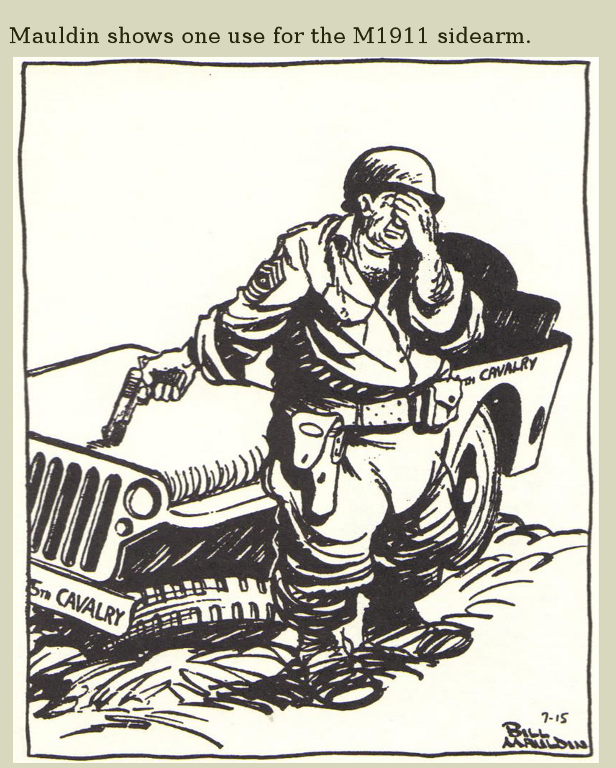
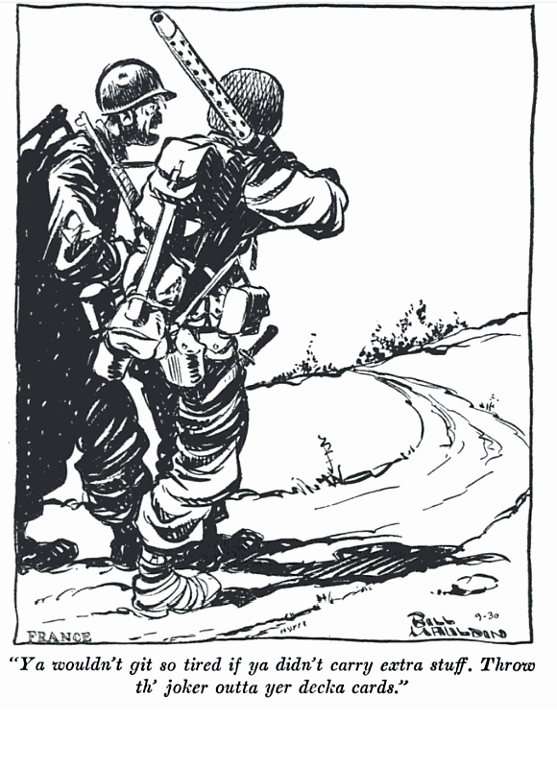
p.p.s. Here are a couple of Mauldin cartoons, for old time sake.
 .
. .
.p.p.p.s. It's official. Gov. Herbert signed the bill. I did make one last ditch effort in a vain attempt to get the bill vetoed. I wrote this and emailed it to the governor:
Dear Governor Herbert:
Please, veto the bill designating the M1911 as the state gun. I think it is much more appropriate to honor the man himself, John M. Browning, rather than a military weapon. You did the right thing by designating a "John M. Browning" day, to honor an important Utah inventor.
Of all the arguments that I heard against the bill, for me the most convincing was that school children in the primary grades do "coloring" exercises to learn about the state symbols. If you sign this bill, then kids will be coloring in the M1911 .45 caliber automatic handgun, right along with the sego lily, seagull, and blue spruce. I think a handgun is totally out of place in that context- it just doesn't fit in that set of items. I wrote a tongue-in-cheek letter to the Salt Lake Tribune which attempted to point out that absurdity. In that letter, I wrote that if Utah were to choose any gun to honor Browning, that we choose his M2HB, the famous .50 caliber heavy machine gun, instead. I know when I was in the third grade, I was constantly drawing planes, tanks, and trucks, always equipped with machine guns! I see one important difference: people don't actually possess machine guns, while it is quite likely that they do have handguns. That means if kids look through their parent's drawers, they just might find a dangerous firearm, and they might think it's just as harmless as a seagull!
There's just no need to allow this become law and make Utah the first state with an "officially designated firearm." The intent to honor Browning will be lost in the controversy, and it will end up being just as much of an embarrassment to Utah. The bill's author's intent was to honor Browning. I urge you to send this back to the legislature by asking them to honor the man himself, not one of his many inventions. I agree that Browning should be elevated along with other great and innovative Utahns, which include Farnsworth, Sorensen, and Huntsman. We don't honor Farnsworth for one of his patents; we honor the sum of his achievements which resulted in television.
Signed,
Douglas D. Mayne
Monday, January 24, 2011
RAID 1 with offline elements
I created this webpage and submitted it for comments at comp.os.linux.misc.
Thursday, January 20, 2011
On Point : Stuxnet
Yesterday's On Point discussed the Stuxnet worm. The guests were very much in favor of deploying the worm, and weren't shying away from calling it a weapon of war. They thought that it was a good alternative to a physical attack (airstrike). A few callers questioned the attack on the grounds that we have no declaration of war against Iran and that the attack was a covert operation. The host pointed out that the recipient of the attack can reverse engineer the "bomb," and potentially point it back at us. At least one caller amplified that theme. The guests responded that we are already under attack daily, and that we better be prepared for threats that can emerge very quickly. This kind of cyber attack may not be confined to computer networks. For example, one of the guests mentioned that enemies have surveyed our electrical grid for vulnerabilities. If I remember correctly, the Y2k disaster scenarios included failure of certain types of programmable controllers, perhaps similar to the ones targeted by Stuxnet, that are widely deployed in all kinds of industrial settings.
The stuxnet worm included four different attack scenarios using four different Windows zero day bugs. To me it seems that is a real grey area. The white-hat security researchers look for bugs in order to fix the OS; black hats find holes that they can exploit for profit. The "gray hats" are apparently at work finding holes that they can exploit to harm enemies.
Here is a link to the discussion.
Update: 2011-01-26
Slashdot reported recently that cybercriminals are finding that Windows is "tapped out" and are gearing up to attack other platforms. Whether that is really true, or not is debatable. (My WAG is that the Windows field is still ripe and there are easy pickins' for the taking.) However, others have already noted that a successful attack against unix (and its variants) would definitely be worth something to bad guys because the core of online sites are hosted on a unix-variant platform.
I thought this AC comment was on the mark.
Update: 2011-03-15
On the Media picked up the discussion. The point is made that it is "Hiroshima moment" in warfare. Stuxnet is a new type of weapon that was developed to target a specific enemy. It is the first salvo in the age of cyber-warfare.
The stuxnet worm included four different attack scenarios using four different Windows zero day bugs. To me it seems that is a real grey area. The white-hat security researchers look for bugs in order to fix the OS; black hats find holes that they can exploit for profit. The "gray hats" are apparently at work finding holes that they can exploit to harm enemies.
Here is a link to the discussion.
Update: 2011-01-26
Slashdot reported recently that cybercriminals are finding that Windows is "tapped out" and are gearing up to attack other platforms. Whether that is really true, or not is debatable. (My WAG is that the Windows field is still ripe and there are easy pickins' for the taking.) However, others have already noted that a successful attack against unix (and its variants) would definitely be worth something to bad guys because the core of online sites are hosted on a unix-variant platform.
I thought this AC comment was on the mark.
Update: 2011-03-15
On the Media picked up the discussion. The point is made that it is "Hiroshima moment" in warfare. Stuxnet is a new type of weapon that was developed to target a specific enemy. It is the first salvo in the age of cyber-warfare.
Thursday, January 6, 2011
File Deduplication in bash
I submitted this script for comments to comp.os.linux.misc
Update: 2011-02-11
I added a feature that for files to be considered for more checking both the file name and file size must match exactly. Here is the latest version.
Update: 2011-02-11
I added a feature that for files to be considered for more checking both the file name and file size must match exactly. Here is the latest version.
Sunday, January 2, 2011
Russian Government Mandates GNU/Linux
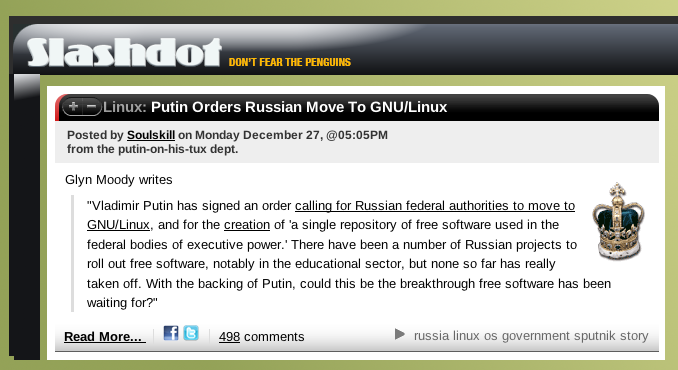
Russia is the latest government to initiate the switch to GNU/Linux. They follow after China and Cuba. There have been other governmental mandates which have had varied success and staying power. Here is Slashdot's
 headline.
There needs to be some commitment to stick with it because there can be some pain during the transition period. Users may push back when pushed away from their comfort zone. They are more likely to stick with it if they know there is a payoff in the end. For example, they could have the incentive of keeping their jobs because they know their salaries are in part paid for by capturing the Microsoft tax. Some of the cynical comments on the Slashdot posting also hit the nail on the head. They guessed that Vladimir Putin could be posturing for a big discount from Microsoft by just threatening to move to GNU/Linux. That could certainly be true, and the monopolist is likely to comply with a cost incentive. However, if Russia doesn't follow through, it will be too bad. GNU/Linux is certainly very usable as a desktop and server OS at this point, not to mention its resounding success and acceptance on Android devices. Big government backing could be the final piece of the puzzle to break the monopolist's agenda to maintain its predatory price structure.
 headline.
There needs to be some commitment to stick with it because there can be some pain during the transition period. Users may push back when pushed away from their comfort zone. They are more likely to stick with it if they know there is a payoff in the end. For example, they could have the incentive of keeping their jobs because they know their salaries are in part paid for by capturing the Microsoft tax. Some of the cynical comments on the Slashdot posting also hit the nail on the head. They guessed that Vladimir Putin could be posturing for a big discount from Microsoft by just threatening to move to GNU/Linux. That could certainly be true, and the monopolist is likely to comply with a cost incentive. However, if Russia doesn't follow through, it will be too bad. GNU/Linux is certainly very usable as a desktop and server OS at this point, not to mention its resounding success and acceptance on Android devices. Big government backing could be the final piece of the puzzle to break the monopolist's agenda to maintain its predatory price structure.
Tuesday, December 28, 2010
DIY: Slackware on USB Flash (8G)
As mentioned in my previous post, it is possible to use an 8G flash drive, instead of the larger (and pricier) 16G version.
Misc. Notes
This layout still gives the option to boot into one of two modes: either the live mode where changes are written to RAM only, or the persistent mode where changes are written to the flash drive (to partition 5). The user is advised to watch the amount of free space left in the snapshot. For the live mode, the amount of free space depends on the amount of RAM installed on the hardware. For the persistent mode, I have set the size of partition 5 to allow for roughly 4G of changes. I think that should work because 4G of changes plus 4G of static data in the base layer equals 8G total in the root filesystem. However, use this project at your own risk! For example, if you need files from the persistent snapshot, then it is possible to back them up externally. You can save them using a simple backup method, say, login as root and use tar to backup the files in question. If you want to hear about other possible backup methods, then just ask.
Here is my previous graphic, updated to show the new layout, setup on an 8G flash drive.
 1.
1.
An 8G file on a 4G partition seems to be impossible at first glance. The trick is to store the base layer on a sparse file. XFS supports sparse files, that means blocks are not allocated until they are actually used. The file is first allocated with the command sequence:
If you want to directly install the base layer into this container, then it is probably a good idea to limit the initial extent to 4G. This will prevent running out of space prematurely, and we can fix it up later.
Install the packages you want using installpkg (with the specified root.) Then after the base layer contains all the expanded packages, you can resize it.
From now on, make minimal changes to the file holding the image. If you make too many changes, you could really run out of space. Also, if you attempt to backup the file with tar, the OS provides data for the sparse blocks- in effect expanding it on the fly. This may present another problem and may not be what you want. I used a slightly different tactic to avoid that problem. In any case, don't change the file if you have started using the persistent snapshot on partition 5! This is because the base layer must remain constant and changes go to the "top" layer. Restated, if you change the base layer, you must also reinitialize the persistent snapshot! Be careful!
Update: 2010-12-31
Here is some introductory documentation for the set of test devices that I have been working on.
Update: 2011-04-07
I have added this post which discusses my startup environment in more detail.
Misc. Notes
This layout still gives the option to boot into one of two modes: either the live mode where changes are written to RAM only, or the persistent mode where changes are written to the flash drive (to partition 5). The user is advised to watch the amount of free space left in the snapshot. For the live mode, the amount of free space depends on the amount of RAM installed on the hardware. For the persistent mode, I have set the size of partition 5 to allow for roughly 4G of changes. I think that should work because 4G of changes plus 4G of static data in the base layer equals 8G total in the root filesystem. However, use this project at your own risk! For example, if you need files from the persistent snapshot, then it is possible to back them up externally. You can save them using a simple backup method, say, login as root and use tar to backup the files in question. If you want to hear about other possible backup methods, then just ask.
Here is my previous graphic, updated to show the new layout, setup on an 8G flash drive.
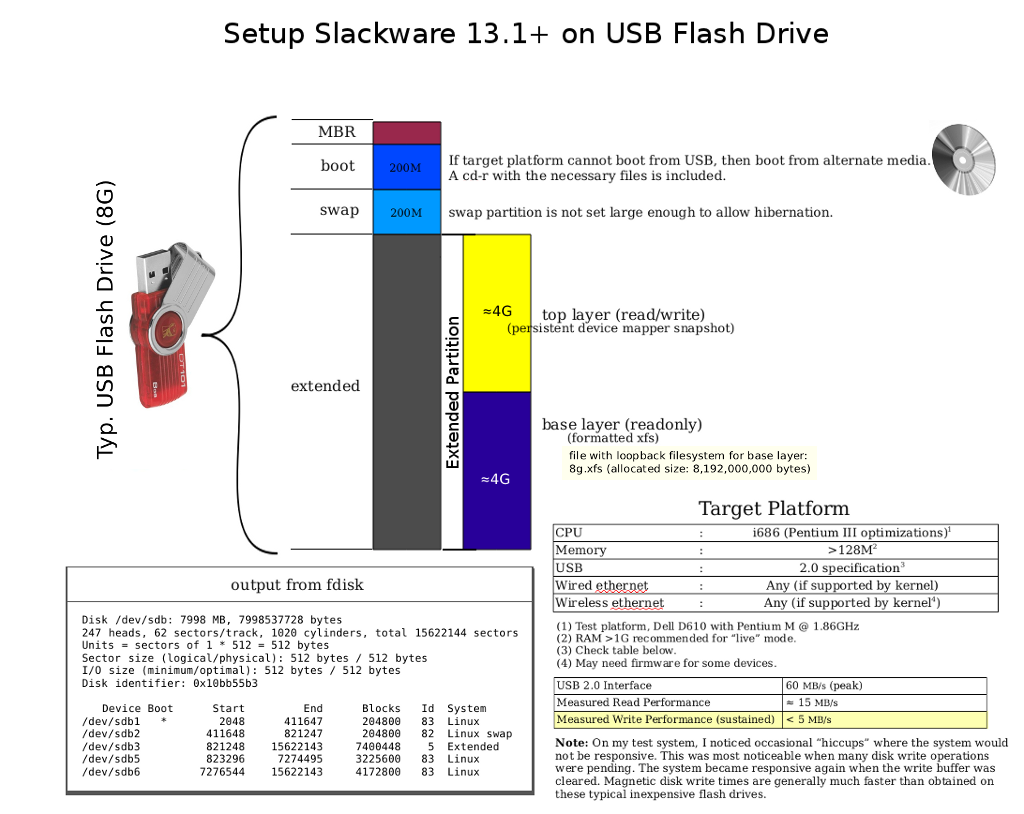 1.
1.An 8G file on a 4G partition seems to be impossible at first glance. The trick is to store the base layer on a sparse file. XFS supports sparse files, that means blocks are not allocated until they are actually used. The file is first allocated with the command sequence:
# dd if=/dev/zero of=8g.xfs bs=1024 count=0 seek=8000000
If you want to directly install the base layer into this container, then it is probably a good idea to limit the initial extent to 4G. This will prevent running out of space prematurely, and we can fix it up later.
# losetup /dev/loop0 8g.xfs
# echo 0 8000000 linear /dev/loop0 0 | dmsetup create 4g
# mkfs.xfs /dev/mapper/4g
# mount /dev/mapper/4g /mnt/floppy
Install the packages you want using installpkg (with the specified root.) Then after the base layer contains all the expanded packages, you can resize it.
# umount /mnt/floppy
# dmsetup remove 4g
# mount /dev/loop0 /mnt/floppy
# xfs_growfs /mnt/floppy
# umount /mnt/floppy
# losetup -d /dev/loop0
From now on, make minimal changes to the file holding the image. If you make too many changes, you could really run out of space. Also, if you attempt to backup the file with tar, the OS provides data for the sparse blocks- in effect expanding it on the fly. This may present another problem and may not be what you want. I used a slightly different tactic to avoid that problem. In any case, don't change the file if you have started using the persistent snapshot on partition 5! This is because the base layer must remain constant and changes go to the "top" layer. Restated, if you change the base layer, you must also reinitialize the persistent snapshot! Be careful!
Update: 2010-12-31
Here is some introductory documentation for the set of test devices that I have been working on.
Update: 2011-04-07
I have added this post which discusses my startup environment in more detail.
Subscribe to:
Posts (Atom)