Today's On Point discusses how both Facebook and Google are changing their privacy policies. They discuss the pros and cons of these changes and completely new offerings. New to the Google mix is the Android phone penetration, which enables phone providers and Google to gather geographic and on-the-spot information.
Download mp3 audio
Audio split into 4 parts:
1.
2.
3.
4.
Showing posts with label privacy. Show all posts
Showing posts with label privacy. Show all posts
Wednesday, February 1, 2012

Sunday, October 16, 2011
A Funny Comic (Rage Meme)

I found this online. I wish I could find the original poster to give proper credit.
Thursday, May 26, 2011
Aliases and Imposters on Facebook
Not the Susan Arnout Smith you were looking for?
Facebook users face a problem, the non-uniqueness of given names. Up until recently anyone could create a facebook profile page using whatever name they wanted. The movie catfish shows the case where non-existent people are created for sock-puppetry and fraud. Consider this radio show as Catfish, Chapter 2. This story details another side of the same coin: people maliciously creating believable imposter pages to damage the reputation of real people. The individual targeted for identity forgery was novelist Susan Arnout Smith. At the end the program, the host mentions that their program was successful in reaching a customer service department at facebook, who say that more safety checks are in place now to properly identify potential fraud. This radio show can get results where mere mortals cannot, very much in the style of getting results only after shining the bright light media scrutiny.
Audio is cached here:
1.
2.

Facebook users face a problem, the non-uniqueness of given names. Up until recently anyone could create a facebook profile page using whatever name they wanted. The movie catfish shows the case where non-existent people are created for sock-puppetry and fraud. Consider this radio show as Catfish, Chapter 2. This story details another side of the same coin: people maliciously creating believable imposter pages to damage the reputation of real people. The individual targeted for identity forgery was novelist Susan Arnout Smith. At the end the program, the host mentions that their program was successful in reaching a customer service department at facebook, who say that more safety checks are in place now to properly identify potential fraud. This radio show can get results where mere mortals cannot, very much in the style of getting results only after shining the bright light media scrutiny.
Audio is cached here:
1.
2.
Wednesday, December 15, 2010
Stand up for the Bill of Rights? Anyone? Beuller?
This story is one that slips under the radar, but it has the potential to be as big of story as the warrantless wiretapping cases. This is another case with widespread implications for computer network security. IPSEC is a separate TCP/IP protocol designed for creating encrypted tunnels suitable for VPN traffic. For example, it is widely used to create encrypted tunnels between "home office" and "branch office" networks. The general idea is to create a wide area network with connections via the internet over secure and encrypted tunnels. The potential compromise of OpenBSD's IPSEC implementation raises serious security concerns because OpenBSD's permissive license allowed it to be used on a lot of hardware, especially "dedicated" VPN boxes.
This is a story to watch. A bunch of people are going to be taking a second look at the code. If it turns out there is a backdoor, it will be especially ironic because Theo de Raadt forked OpenBSD from FreeBSD mostly because he insisted on better security code auditing.
Here is Slashdot's headline.
Also,
The Fourth Amendment doesn't really count for much any more. The disposition of the Mark Klein case is discouraging. I heard part of this interview.
Here it is broken into 10 minute segments:
1.
2.
3.
4.
5.
This is a story to watch. A bunch of people are going to be taking a second look at the code. If it turns out there is a backdoor, it will be especially ironic because Theo de Raadt forked OpenBSD from FreeBSD mostly because he insisted on better security code auditing.
Here is Slashdot's
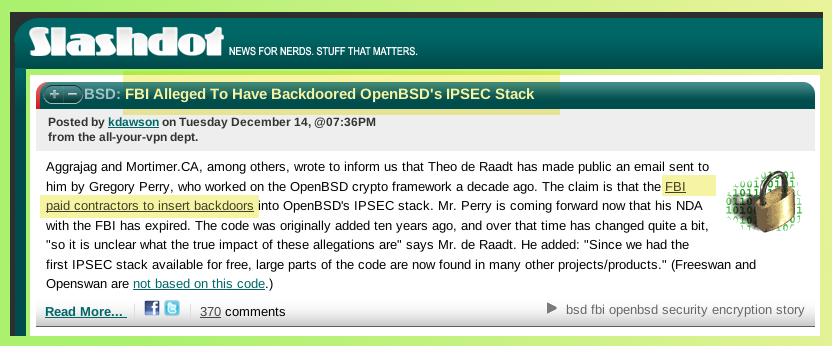 headline.
Also,
The Fourth Amendment doesn't really count for much any more. The disposition of the Mark Klein case is discouraging. I heard part of this interview.
Here it is broken into 10 minute segments:
1.
2.
3.
4.
5.
Monday, December 6, 2010
Facebook and tipping points...
This comment on this morning's Slashot story on the latest Facebook infraction got me thinking about how it meshes with Malcolm Gladwell's "The Tipping Point." It's been a while since I read it, but I remember the gist of it well enough: The cool kids set trends and move on when its played out. Gladwell's examples were scooters and hush puppies. It used to be that Wayne and Garth would define the new and cool lexicon, cha! That worked until they themselves realized they weren't "worthy." (Oh, yeah! Hangin' with Alice Cooper! We're not worthy...we're not worthy!)
Social media sites are all about tipping points. If not enough people participate, then that amounts to a few empty voices crying into the wilderness. They all strive to reach "critical mass," where "everyone" is online (everyone has a telephone, has a television, has a myspace account, etc.). If you're a straggler, then you're just late to the party. Whatever you have to say must not be that important afterall. I was thinking about this, then the realization hit me: I have the power that William H. Macy's "Berny Lootz" had in the The Cooler. If I were to join Facebook, the whole thing would come crashing down. They'd better consider paying me to stay away! (I hope they don't send Alec Baldwin after me with a baseball bat...)
Social media sites are all about tipping points. If not enough people participate, then that amounts to a few empty voices crying into the wilderness. They all strive to reach "critical mass," where "everyone" is online (everyone has a telephone, has a television, has a myspace account, etc.). If you're a straggler, then you're just late to the party. Whatever you have to say must not be that important afterall. I was thinking about this, then the realization hit me: I have the power that William H. Macy's "Berny Lootz" had in the The Cooler. If I were to join Facebook, the whole thing would come crashing down. They'd better consider paying me to stay away! (I hope they don't send Alec Baldwin after me with a baseball bat...)
Saturday, May 22, 2010
Negative Publicity for Facebook Mushrooming
The Wall Street Journal reported yesterday that Facebook has been delivering non-aggregated user profile data to its advertisers when users click on an ad. The mechanism is the so-called referrer page. Advertisers have been free to collect this information to build a sophisticated consumer profile to target in the future. However, the WSJ's report does not include instances of this behavior, but it is not the kind of thing advertisers would like generally known. This is usually covered as "proprietary methods," that one advertiser uses to gain an advantage over another. The WSJ's report is here. (Read it before Rupert Murdoch takes it down.)
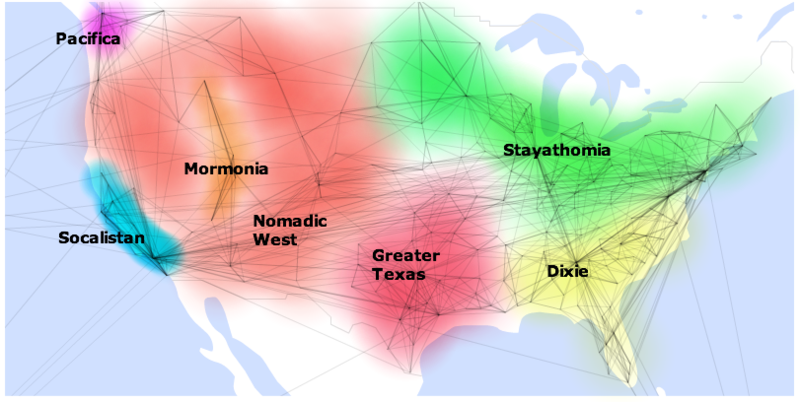
To see the power of Facebook's internal API's that allow direct querying of user information, check this
 graphic.
If I remember correctly, this graphic was generated by a single individual who used the documented APIs to query Facebook's database. It generated some discussion at the time because a lot of people thought it was an abuse of privacy, including the lords at Facebook who asked him to destroy his project and data.
Also yesterday, NPR's Science Friday joined the fray in nipping at Facebook's jugular. Science Friday has been an early adopter of every online community- at least, second life, facebook, and twitter. I really like the program and the podcast, but all of that "joining" has never been for me.
Note: The above includes some textual revisions from the original.
To see the power of Facebook's internal API's that allow direct querying of user information, check this
 graphic.
If I remember correctly, this graphic was generated by a single individual who used the documented APIs to query Facebook's database. It generated some discussion at the time because a lot of people thought it was an abuse of privacy, including the lords at Facebook who asked him to destroy his project and data.
Also yesterday, NPR's Science Friday joined the fray in nipping at Facebook's jugular. Science Friday has been an early adopter of every online community- at least, second life, facebook, and twitter. I really like the program and the podcast, but all of that "joining" has never been for me.
...Get a free T-shirt for your avatar in Second Life on Science Friday Island. I'm Ira Flatow in New York.
Note: The above includes some textual revisions from the original.
Subscribe to:
Posts (Atom)